
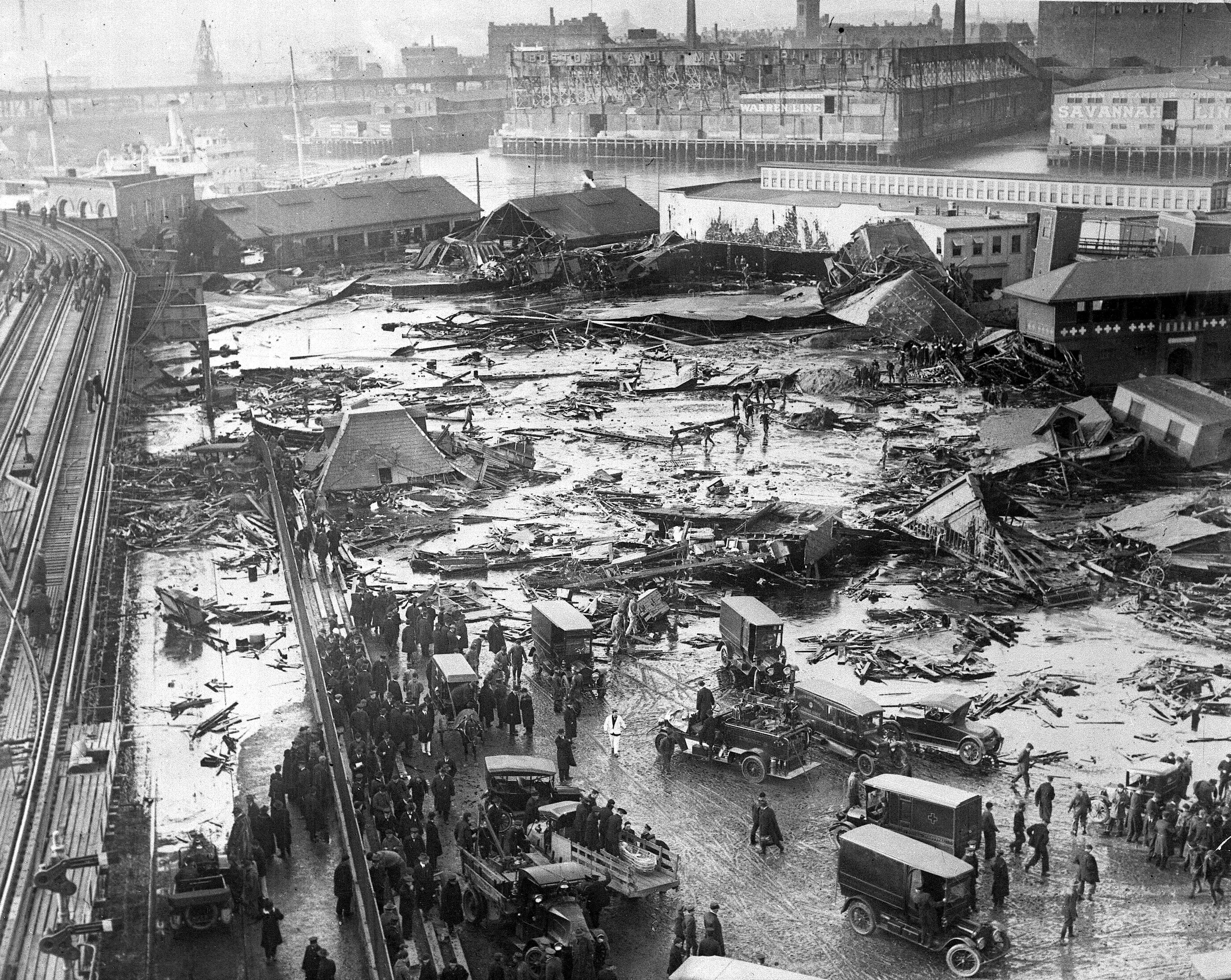
Panorama of the Molasses Disaster site, 15 January 1919 — Globe Newspaper Co., via Boston Public Library; public domain, via Wikimedia Commons.
The Great Molasses Flood of 1919: Boston's Strangest Disaster — and the Safety Laws It Created
On a mild January lunchtime in 1919, Boston's North End was hit by a flood — not of water, but of molasses. A storage tank the size of a five-storey building burst open on Commercial Street, sending more than two million gallons of the thick, dark syrup racing through the streets at an estimated 35 miles per hour. Twenty-one people were killed and about 150 injured, buildings were knocked off their foundations, and an elevated railway was nearly swept from its tracks.
It sounds like a joke. It was a tragedy — and the investigation that followed changed how America builds.
Why Boston was swimming in molasses
Molasses is the dark syrup left over when sugar cane is refined, and in 1919 it was big business. Fermented, it produces industrial alcohol — the key ingredient in munitions — and during the First World War demand for it soared. The Purity Distilling Company, a subsidiary of United States Industrial Alcohol (USIA), stored its molasses in a giant tank on Boston's waterfront at 529 Commercial Street, in the crowded, working-class North End, and piped it across the harbour to its distillery in Cambridge.
There was a second reason the tank was full that winter. The 18th Amendment, which would ban the manufacture and sale of alcohol in the United States, was ratified on 16 January 1919 — the day after the disaster. With Prohibition about to take effect, the company was stockpiling molasses to turn into rum while it still could. Two days before the flood, a fresh shipment arrived from Puerto Rico and was pumped into the tank.
The tank everyone knew was failing
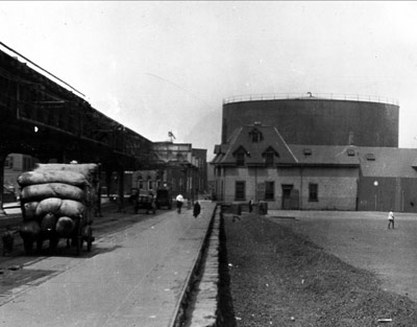
The molasses tank in Boston's North End before its collapse — The Bostonian Society, public domain, via Wikimedia Commons.
The tank had been built in 1915, in a hurry, for about $30,000. It stood 50 feet tall and 90 feet across, made of curved steel plates held together with rows of rivets, and it could hold up to 2.3 million gallons. It was designed and built under a company manager with no engineering training, and it was never properly tested before being filled.
The steel was too thin for the load, the rivets too few, and the tank had only ever been filled to capacity a handful of times. Worst of all, it leaked from the start. Molasses seeped through the seams so steadily that the company painted the tank brown to hide the stains, and neighbourhood children came with pails to collect the drips. Workers reported that the tank groaned loudly whenever a fresh load was pumped in.
The tank leaked from the day it was built, was never properly tested, and was painted brown to hide the seepage — and the company filled it to capacity anyway.
On 15 January 1919, Boston woke to an unusually warm day for midwinter. Temperatures climbed from near 2 degrees Fahrenheit the day before to around 40 degrees by midday, and the fresh, warm Caribbean molasses inside the tank was several degrees warmer than the cold molasses already there. The tank had been filled almost to the brim. At about 12:30 p.m., as workers sat down to lunch nearby, it gave way.
Twelve-thirty on January 15

Wreckage under the elevated railway tracks after the flood — public domain (photograph published 1919), via Wikimedia Commons.
Witnesses first heard a sound like machine-gun fire — steel rivets tearing loose and whistling through the air. Then the side of the tank split open and 2.3 million gallons of molasses, weighing an estimated 26 million pounds, poured out. Accounts differ on the height of the wave — from about 8 feet to 25 feet, with some reports claiming as much as 40 — but all agree on its speed: roughly 35 miles per hour, in a wall some 160 feet wide.
The wave smashed through the North End. It knocked buildings off their foundations, crushed cars, broke the steel girders of the Boston Elevated Railway and almost swept a train off its tracks. A section of the tank crashed through the neighbouring firehouse, killing firefighter George Layhe. Ten-year-old Pasquale Iantosca, who had been gathering firewood near the tank, was killed when a railroad car was hurled into him. The Boston Post reported the next day: "Molasses, waist deep, covered the street and swirled and bubbled about the wreckage… Here and there struggled a form — whether it was animal or human being was impossible to tell."
The first rescuers on the scene were 116 sailors from the lightship USS Nantucket, docked nearby, soon joined by police, firefighters, soldiers and Red Cross workers. But the rescue was almost impossible. As the molasses spread into the cold streets it cooled and thickened into a heavy, cement-like mass that pinned victims in place. Many of those who died suffocated, trapped where they had fallen. It took some 87,000 man-hours to clean the streets, with workers finally discovering that salt water from the harbour dissolved the sticky residue.
Twenty-one people were killed and about 150 injured — most of them working-class Italian and Irish immigrants, longshoremen, teamsters and children of the North End.
The blame game
United States Industrial Alcohol refused to accept responsibility. Its lawyers claimed the tank had been blown up by saboteurs — Italian anarchists, they suggested, in a city where fears of radical bombings ran high after the war. No evidence of a bomb was ever found.
The official inquiries told a different story. In February 1919, Boston Municipal Court Chief Judge Wilfred Bolster reported that the tank had been "wholly insufficient in point of structural strength to handle its load". An MIT civil engineer who examined pieces of the shattered tank, Charles Spofford, found its shell too thin and held together with too few rivets. A grand jury blamed the city for failing to inspect the tank's plans and construction, but stopped short of charging the company with manslaughter.
The victims' families took the company to court. By August 1920, 119 separate lawsuits had been filed, and they were consolidated into one of the first class-action suits in Massachusetts history. The hearings dragged on for more than three years, with the court-appointed auditor, Colonel Hugh W. Ogden, listening to more than 900 witnesses. On 28 April 1925, Ogden delivered his 51-page report: the company was liable, and its negligent construction of the tank had caused the disaster. United States Industrial Alcohol eventually paid about $628,000 in settlements to the victims and their families.
Why the cold made it deadlier
For almost a century, one question puzzled historians: how could slow, sticky molasses move at 35 miles per hour? In 2016, a team of Harvard researchers led by Nicole Sharp, with Jordan Kennedy and Shmuel Rubinstein, finally answered it. Presenting their work to the American Physical Society, they showed that the fresh Caribbean molasses had been 7 to 9 degrees Fahrenheit warmer than the Boston air. Molasses flows fast while it is warm — it thins under stress — so the first surge raced through the streets. But as it spread and cooled, its viscosity increased fourfold or more, turning from a fast liquid into a trap.
The cold was what made the flood lethal: the molasses rushed out warm and fast, then cooled and hardened around its victims so quickly that rescuers could not pull them free.
The legacy written in building codes
The molasses flood was not just a freak accident; it became a turning point in American engineering. Massachusetts tightened its building codes, and the disaster helped drive a national movement: states began requiring that plans for major structures be designed on sound engineering principles and sealed by a licensed professional engineer before a permit would be issued. The professional engineering licence — today a standard requirement across the United States — spread in the disaster's wake, and the long trial set a precedent for holding companies liable for negligent construction.
It was a strange legacy for a strange disaster: a flood of syrup that left behind the rules that keep American buildings, bridges and tanks standing today.
What remains
The tank was never rebuilt. Its site, on the waterfront at the edge of the North End, is now Langone Park — a ballfield, playground and bocce courts — with a small plaque at the entrance to neighbouring Puopolo Park marking the spot where 21 people died. Boston tour guides still slow down to tell the story, and one of the city's amphibious tour vehicles is named "Molly Molasses".
Local folklore adds one last detail: that on hot summer days, more than a century later, the North End still smells faintly of molasses. It is a legend, not a fact — but it shows how deeply the strangest disaster in Boston's history lodged itself in the city's memory.
Read our article on the Peshtigo Fire, America's deadliest wildfire, and browse the Forgotten History archive.
References
- Encyclopaedia Britannica — "Great Molasses Flood": https://www.britannica.com/topic/Great-Molasses-Flood
- Smithsonian Magazine — "The Sticky Science Behind the Deadly Boston Molasses Disaster" (28 November 2016): https://www.smithsonianmag.com/smart-news/why-boston-molasses-disaster-was-so-deadly-180961209/
- History Today — Chuck Lyons, "A Sticky Tragedy: The Boston Molasses Disaster": http://www.historytoday.com/chuck-lyons/sticky-tragedy-boston-molasses-disaster
- Live Science — "Great Molasses Flood of 1919: Why This Deluge of Goo Was So Deadly": https://www.livescience.com/56947-why-molasses-flood-1919-was-deadly.html
- Lehigh University Archives — Albert Ladd Colby Report on the Boston Molasses Tank (1919–1922): https://archivesspace.lib.lehigh.edu/repositories/3/resources/260/collection_organization
- Liberty University Digital Commons — "A Preventable Tragedy: Taking a Look at the Great Molasses Flood in Boston, 1919 and its Effect on the United States": https://digitalcommons.liberty.edu/cgi/viewcontent.cgi?article=3089&context=research_symp
- Scholastic SuperSTEM — "Swept Away by Syrup!": https://superstem.scholastic.com/issues/2025-26/030126/syrup.html
- Stephen Puleo, Dark Tide: The Great Boston Molasses Flood of 1919 (Boston: Beacon Press, 2004) — the only full-length book on the disaster.
Fact notes: Estimates of the wave's height vary widely between sources — from about 8 feet to 25 feet, with some accounts claiming up to 40 feet — so the article gives the range rather than a single figure; the 35 mph speed and 160-foot width are the commonly cited estimates, not instrument readings. The exact cause of the tank's failure is not known with certainty; the court found the company liable for negligent construction, while the company's sabotage theory was never supported by evidence. The claim that the North End still smells of molasses on hot days is local folklore, not an established fact. The number of witnesses heard by auditor Hugh W. Ogden is given as more than 900 (History Today); some secondary sources cite higher figures. The Harvard team's 2016 findings were presented to the American Physical Society, not published as a peer-reviewed paper on the disaster itself.
Comments
Post a Comment