
The Library of Alexandria: The Greatest Library of the Ancient World — and Why It Didn't Burn in One Night
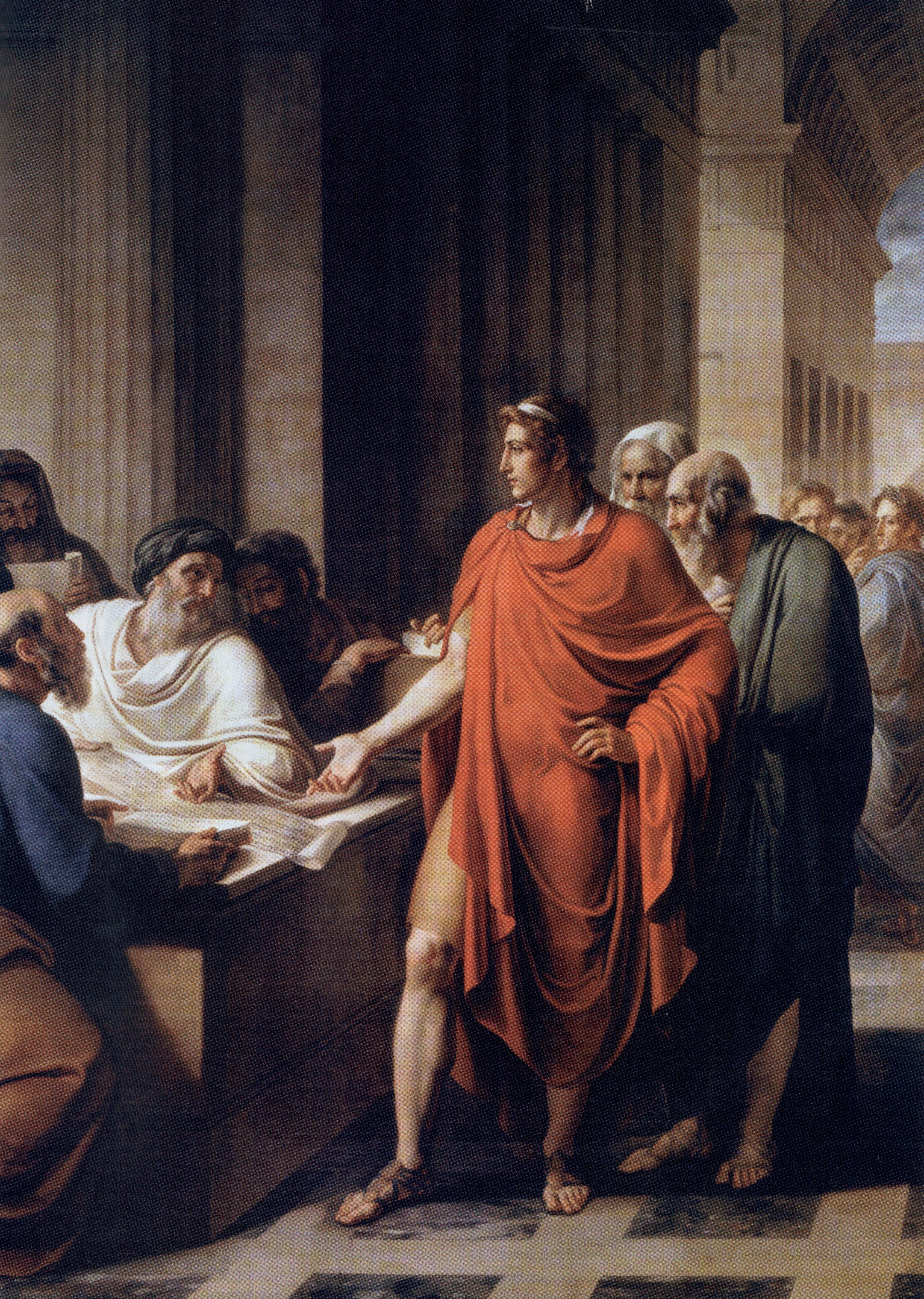
Vincenzo Camuccini, Ptolemy II Philadelphus in the Library of Alexandria, 1813 — public domain, via Wikimedia Commons.
Everyone knows the story: the greatest library of the ancient world burned in a single night, and a thousand years of knowledge went up in smoke. It is one of the most repeated tales in history — and it is mostly wrong.
The Library of Alexandria was real, and it was extraordinary: the largest collection of books in the ancient world, attached to a research institute where scholars were paid to think. But no single fire destroyed it. What happened was slower: over some six centuries the money stopped, the scholars left, wars damaged the district around it, and papyrus rotted because nobody was paid to copy it.
A city built to collect
Alexander the Great founded Alexandria in 331 BCE, on Egypt's Mediterranean coast at the western edge of the Nile Delta. When he died eight years later, his empire was divided among his generals, and Ptolemy I Soter took Egypt, making Alexandria his capital.
The idea is credited to Demetrius of Phaleron, an exiled Athenian statesman who became Ptolemy I's adviser. According to the Letter of Aristeas, written in the 2nd century BCE, Demetrius proposed collecting every book in the world in one place. Ptolemy I approved the plan around 295 BCE, and the library was built and filled under his son, Ptolemy II Philadelphus (r. 285–246 BCE).
The library was not a warehouse of books. It was part of the Mouseion — the "shrine of the Muses" — a state-funded research institute where scholars were given salaries, free meals and lodging, and told to study. It was, in effect, the world's first university.
The ambition was total: a universal library holding every book in the world, in every language. Greek dominated the collection, but works in Egyptian, Hebrew, Persian and other languages were collected and translated. The most famous project was the Septuagint, the Greek version of the Hebrew Bible — according to the Letter of Aristeas, the work of 72 Jewish scholars brought to Alexandria under Ptolemy II. That story is legend, but the translation itself is real, and it was made in Alexandria.
How many scrolls?
How big was the library, really? We do not know, and neither did anyone in antiquity — the library left no inventory. Ancient sources give wildly different figures for the collection: anywhere from 40,000 to 700,000 scrolls, with 400,000 to 500,000 the most commonly repeated. Modern scholars warn these figures cannot be trusted — ancient writers inflated numbers for effect, and a "scroll" was not a "book": a single work might run to many scrolls, and many scrolls were duplicates.
The collection was the largest in the ancient world, including works that existed nowhere else. A second, smaller library was later built at the Serapeum, the temple of Serapis in the city, said to have held tens of thousands of scrolls.
The hunt for books

O. Von Corven, The Great Library of Alexandria, 19th century — public domain, via Wikimedia Commons.
The Ptolemies did not wait for books to come to them. They went out and took them — by purchase, by copying, and sometimes by outright seizure.
According to the physician Galen, writing centuries later, every ship docking at Alexandria was searched for books. Any scroll found was taken to the library, copied, and the copy — not the original — was returned to the owner. Under Ptolemy III Euergetes (r. 246–221 BCE), the policy grew bolder: he borrowed Athens' official copies of the tragedies of Aeschylus, Sophocles and Euripides, leaving a deposit of 15 talents of silver, then kept the originals, sent back copies, and forfeited the deposit.
The first head librarian was Zenodotus of Ephesus, a scholar and poet. The great cataloguer was Callimachus of Cyrene, whose Pinakes — the "Tables" — listed authors, titles and short biographies in what later sources say ran to 120 books. It was the first library catalogue of its kind.
The minds of Alexandria
The collection made Alexandria the intellectual capital of the ancient world. Euclid wrote his Elements there around 300 BCE — the geometry textbook used, in one form or another, for more than 2,000 years. The physician Herophilus performed human dissections in Alexandria and founded the scientific study of anatomy. The shelves held Homer, Plato and Aristotle, and the ideas debated there included Aristarchus of Samos's claim that the Earth moves around the Sun — eighteen centuries before Copernicus.
The most famous of its scholars was Eratosthenes of Cyrene, who became head librarian. Around 240 BCE he set out to measure the Earth. At Syene — modern Aswan — the Sun shone straight down a well at noon on the summer solstice, casting no shadow. In Alexandria, on the same day, a vertical stick cast a clear shadow. Measuring that angle at about 7 degrees — roughly one-fiftieth of a circle — and knowing the cities were about 5,000 stadia apart, he multiplied: 50 times 5,000 gave a circumference of 250,000 stadia, later refined to 252,000.
With a stick, a well and a shadow, Eratosthenes measured the Earth to within a few percent — more than 2,000 years before satellites.
How close he came depends on the exact length of the stadion he used, which scholars still debate: his figure converts to roughly 39,000–46,600 kilometres, against the true equatorial circumference of about 40,075 kilometres. Either way, it was one of the greatest measurements in scientific history — made by a librarian, in a library.
The slow death

Charles William Mitchell, Hypatia, 1885 — public domain, via Wikimedia Commons.
The decline began not with fire, but with politics. In 145 BCE, Ptolemy VIII expelled foreign scholars from Alexandria after a dynastic struggle; the head librarian Aristarchus of Samothrace was among those who left. Royal patronage — the money that had made the whole enterprise possible — grew thinner with each generation.
Then came the wounds, one by one. In 48 BCE, Julius Caesar, besieged in Alexandria during his civil war, set fire to ships in the harbour. The fire spread ashore, and ancient writers report that dockside warehouses holding scrolls burned. How much of the collection was lost is debated — and the library plainly survived, since the geographer Strabo describes the Mouseion still functioning around 20 BCE.
In the early 270s CE, the emperor Aurelian retook Alexandria from the breakaway Palmyrene Empire, and the fighting destroyed the Bruchion quarter, the palace district where the library stood. By the 260s CE, the Mouseion's membership appears to have ceased altogether.
In 391 CE, the daughter library at the Serapeum was destroyed, after the emperor Theodosius I ordered pagan temples demolished and the bishop Theophilus of Alexandria carried it out. In 415 CE, Hypatia — the philosopher and mathematician who taught in Alexandria, the most famous scholar associated with the city in its last days — was murdered by a Christian mob. She was not the library's last librarian, as popular retellings claim; the library as an institution was already gone. But her death marks the end of Alexandria as a centre of free scholarship.
The Library of Alexandria did not burn in one night. It faded over six centuries — starved of money, scattered by politics, damaged by war, and finally abandoned.
The legend that blamed a caliph
One more story is still told about the library's end: that when Arab armies conquered Alexandria in the 7th century, the caliph Umar ordered the books burned to heat the city's baths — six months' worth of fuel, the tale says. It is a vivid story — and, by the verdict of modern scholarship, a legend.
No contemporary source mentions it, Christian or Muslim. It first appears in the 13th century, in Ibn al-Qifti's writings, some 600 years after the supposed event. By the 7th century, there is no evidence that a great library collection, or the buildings that would have housed it, still existed in Alexandria. The legend blamed a caliph for a library that was already gone.
What was really lost
What was lost was not a single building, or a single night's fire. It was the collection itself — hundreds of thousands of scrolls, many of them unique, and the scholars who knew what was in them. Most of what the library held is gone: the complete works of Sappho, the lost plays of Sophocles and Euripides, histories, poems and scientific treatises that exist now only as titles quoted by other writers. A scroll's papyrus lasted about 100 years; it survived only if someone copied it. When the money for copying stopped, the collection began to rot.
And yet some of what the library gathered did survive, because copies were made elsewhere, or because the ideas were taken up by later writers. Aristotle's works survive in part because they were copied, carried, edited and recopied — the chain held. Euclid's Elements survived the same way, and was translated into Arabic and Latin, and taught across Europe for more than 2,000 years. The texts that survived were the ones that were copied most often; the ones that existed in only one copy were the ones that vanished.
That is the true cost of the library's slow death: not a single night of fire, but centuries of neglect. The lesson is not about the dangers of fire, but about the fragility of knowledge that is not looked after.
The library reborn
In 2002, on the same stretch of shore, the Bibliotheca Alexandrina opened — a new library in Alexandria, built to hold some eight million books. Its reading room, the largest in the world, seats 2,000 readers under a tilted glass roof like a rising sun. It is not a reconstruction — no one knows what the original looked like, and no remains of it have ever been found. It is a revival of the idea, a place where the world's knowledge is collected, and anyone can come and read.
What killed the ancient library was not a single fire. It was the slow failure to keep paying for knowledge — and that is a warning, not just a story.
The United States learned the lesson in its own way: the Library of Congress in Washington, D.C. — today the largest library in the world, with more than 170 million items — was founded in 1800 on the opposite principle, that a nation's library is worth funding, protecting and copying. Alexandria is the reminder of what happens when that commitment lapses.
Read our article on Göbekli Tepe, the temple built before farming, and browse the Historical Mysteries archive.
References
- Encyclopaedia Britannica — "Library of Alexandria": https://www.britannica.com/topic/Library-of-Alexandria
- World History Encyclopedia — "Library of Alexandria": https://www.worldhistory.org/Library_of_Alexandria/
- World History Encyclopedia — "What Happened to the Great Library at Alexandria?": https://www.worldhistory.org/article/207/what-happened-to-the-great-library-at-alexandria/
- Live Science — "The rise and fall of the Great Library of Alexandria": https://www.livescience.com/rise-and-fall-of-the-great-library-alexandria
- Princeton University — "Measuring the Earth's Curvature": https://www.astro.princeton.edu/~dns/teachersguide/MeasECAct2.html
- Library of Congress — "About the Library": https://www.loc.gov/about/
- UNESCO — "Bibliotheca Alexandrina to be Officially Inaugurated on 16 October": https://www.unesco.org/en/articles/bibliotheca-alexandrina-be-officially-inaugurated-16-october
Fact notes: The founding date is uncertain — Ptolemy I is credited with the plan, Ptolemy II with building it. Scroll totals in ancient sources range from 40,000 to 700,000 and are unreliable. Eratosthenes' 252,000 stadia converts to roughly 39,000–46,600 km depending on the stadion used. The Septuagint origin story in the Letter of Aristeas is legend; the translation itself is real. Hypatia was a philosopher and teacher, not a librarian. The Umar burning story first appears in 13th-century sources and is rejected by modern scholarship.
Comments
Post a Comment