
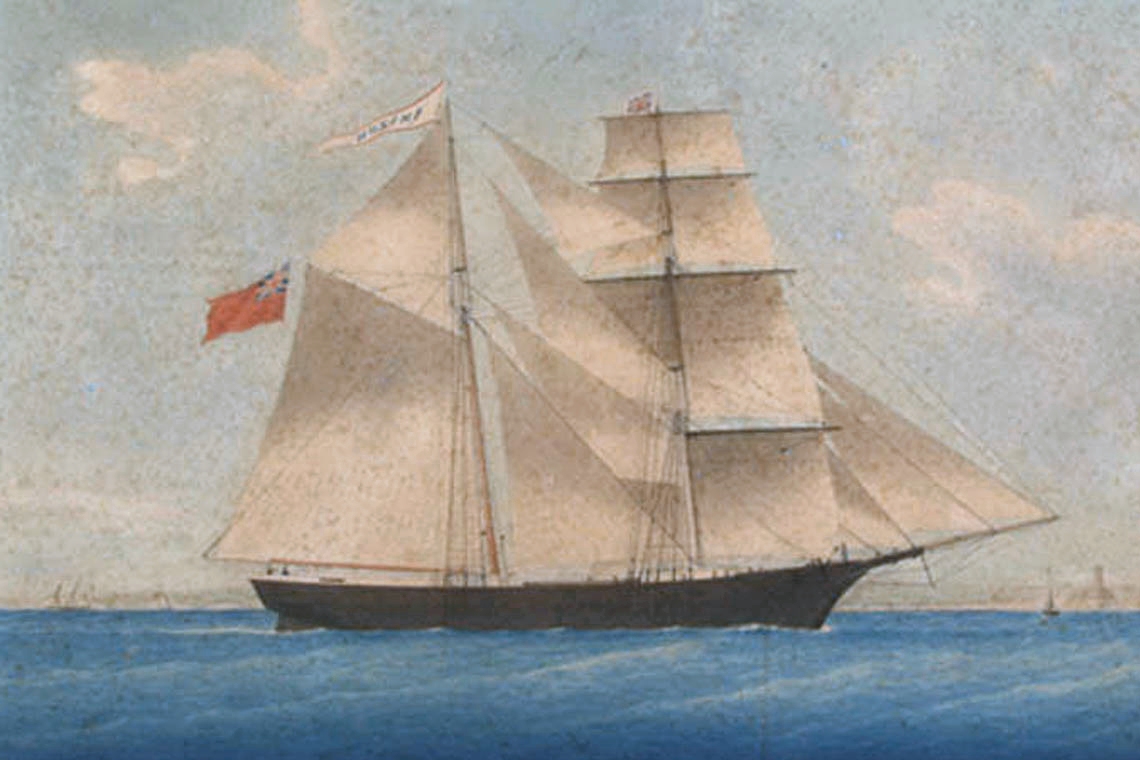
In early December 1872, about 400 miles east of the Azores, the Canadian brigantine Dei Gratia spotted a ship sailing erratically, sails partly set, nobody at the wheel. After watching her for two hours, her crew sent a boarding party across to the American brigantine Mary Celeste, a month out of New York and bound for Genoa. She was sound, seaworthy and well stocked — and empty.
Ten people had sailed in her: her captain, his wife, their two-year-old daughter, and seven crewmen. None was ever seen again. More than 150 years later she is still the most famous ghost ship in history — not because a ship vanished, but because the ship came back and her people did not.
An unlucky ship with a new name
The Mary Celeste began life under another name. She was built in 1861 at Spencer's Island, Nova Scotia, by the shipbuilder Joshua Dewis, and launched on 18 May 1861 as the Amazon. Her early career was unlucky: her first captain died of pneumonia on the maiden voyage, she sank another vessel in a Channel collision, and in 1867 she ran aground at Glace Bay, Nova Scotia, and was abandoned as a wreck.
Salvaged and sold to American owners, she was renamed the Mary Celeste in 1868. Rebuilt in New York in 1872, she measured 282 gross tons and about 100 feet long — an ordinary two-masted merchant brigantine. She sailed uneventfully until the autumn of 1872, when a new part-owner took command.
The voyage from New York
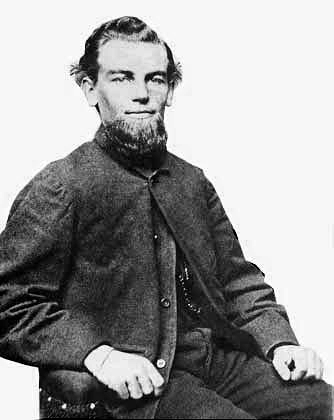
That captain was Benjamin Spooner Briggs, born in Wareham, Massachusetts, on 24 April 1835, one of five sons of a sea captain. He was thirty-seven, experienced and well regarded; this was his first voyage in command after her refit. He took his wife Sarah and their two-year-old daughter Sophia with him, along with seven crewmen: first mate Albert Richardson, second mate Andrew Gilling, steward and cook Edward Head, and four German seamen — the brothers Volkert and Boz Lorenzen, Arian Martens and Gottlieb Goudschaal.
On 7 November 1872 the Mary Celeste sailed from Pier 50 on New York's East River, bound for Genoa, Italy, with 1,701 barrels of commercial alcohol destined for the wine trade. Eight days later the Dei Gratia left New York on a similar route, bound for Gibraltar with petroleum.
After two weeks of heavy weather, the last entry in her log was written on the morning of 25 November, when she was near Santa Maria Island in the Azores, some six nautical miles from land. Then the log falls silent. Nine days later, on 4 December, the Dei Gratia found her.
An empty ship under sail

On 4 December 1872, the crew of the Dei Gratia boarded a sound, well-provisioned ship under sail — and found not a single person aboard.
First mate Oliver Deveau led the boarding party. What he found was strange, but not violent. The ship's only lifeboat, her yawl, was missing, along with her chronometer, sextant and ship's papers — what a captain takes with him in an emergency. The logbook remained, and the crew's belongings lay undisturbed; no blood, no sign of a struggle.
Below decks, about three and a half feet of water sloshed in the hold — enough to worry a captain, not enough to sink a sound ship. One of her two pumps had been taken apart. The fore hatch and lazarette hatch were open, the main hatch secured. The cargo was almost entirely intact; nine of the 1,701 barrels were empty, most likely because they were made of porous red oak and had leaked. She carried six months of food and water.
The missing lifeboat, chronometer, sextant and ship's papers tell the real story: the ten people did not vanish — they left, deliberately, in an orderly evacuation, taking what they needed to navigate a small boat.
Deveau and two men from the Dei Gratia sailed the empty ship some 800 miles to Gibraltar, arriving on 13 December. Which only deepened the question: why would an experienced captain take his wife and small daughter into an open boat in the middle of the Atlantic, and leave a ship that could still sail?
Gibraltar: a court smells a crime
At Gibraltar the Mary Celeste was impounded, and a Vice-Admiralty Court salvage hearing opened on 17 December 1872. It ran until 25 February 1873, because the Attorney General, Frederick Solly-Flood, was convinced the abandonment concealed a crime. He investigated murder, piracy and insurance fraud.
The court found no evidence for any of it. Surveyor John Austin reported cuts on the bow he judged deliberate, and stains on the deck and the captain's sword said to look like blood. But the Gibraltar chemist, Dr J. Patron, analysed the stains on 30 January 1873 and found no blood in either. The court cleared the salvors — but its suspicion showed in the award: the Dei Gratia's crew received only about £1,700, a fraction of the value of the ship and cargo. The ten people were declared lost at sea; no bodies, and no wreckage of the yawl, were ever found.
What the evidence rules out
The record rules out the dramatic explanations. No mutiny: the crew's belongings were untouched, nothing stolen. No piracy: the cargo was intact, the ship undamaged. No fraud by the Dei Gratia: the two ships had sailed a week apart on different business. No sudden catastrophe: the ship was not on fire, not sinking, not dismasted.
The popular image — a breakfast half-eaten, warm cups of tea, a ship frozen mid-moment — is invention, from newspaper embellishments of the 1880s and Arthur Conan Doyle's 1884 short story "J. Habakuk Jephson's Statement", which posed as a survivor's account and gave the ship the misspelt name Marie Celeste. The warm-meal details were never in the court record. The real scene was quieter and stranger: an orderly ship, abandoned in a hurry, by people who took their navigation instruments and left everything else.
The theories — and the one that fits best
With crime ruled out, the serious explanations agree on one thing: Briggs ordered the abandonment himself, believing the ship was in danger. The question is what he feared.
One leading theory, from the Smithsonian Channel's 2007 investigation by Anne MacGregor and oceanographer Phil Richardson, points to the pumps and the chronometer. A pump giving false readings could have convinced Briggs the ship was taking on far more water than it was. A chronometer running slow could have made him believe he was close to the Azores, and therefore close to rescue, when he was in fact hundreds of miles from land. A captain who thinks his ship is sinking and land is near will take his family into the lifeboat. A captain who is wrong about both will lose them.
The other leading theory points to the cargo. Nine leaking barrels had filled the hold with alcohol vapour, and in 2006 the chemist Andrea Sella showed that an alcohol-vapour explosion in a ship's hold can produce a frightening blast without scorching the wood. In spring 2026, Manchester chemists Jack Rowbotham and Frank Mair went further, building a 1:18 scale model for a Channel 5 documentary and igniting ethanol vapour in its hold: the hatches blew off and the planking buckled, yet the blue flame, at around 2,000°C, left no char and no soot. A blast like that would terrify anyone below decks. A captain who had just felt his ship shudder would get his family into the boat and stand off at a safe distance — and a wave, a gust or a parted line could then separate boat from ship forever.
Both theories remain unproven, and neither can be proven now: the yawl, the people and the final pages of the log are all gone. But both fit the evidence — the missing boat and instruments, the open hatches, the water, the leaking barrels, the absence of damage — better than any story of murder or monsters.
How fiction rewrote the story
Without Conan Doyle, the Mary Celeste might have faded into the footnotes of maritime history. His story was so convincing that writers quoted its inventions as fact for decades, and the misspelling Marie Celeste is still used today. Hoax "survivors" appeared over the years; none was authenticated. The ship sailed on for thirteen more years, until in 1885 her captain deliberately wrecked her off Haiti in an attempted insurance fraud — a squalid end for a ship that had become a legend.
The Mary Celeste was never a ghost ship. She was a sound ship whose people made a rational decision in a moment of fear — and the sea kept the rest.
That is why the case still holds us. It is not a story about the supernatural, but about how little separates an ordinary voyage from catastrophe: a faulty pump, a slow chronometer, a cargo leaking invisible vapour, a captain who must decide in minutes whether to trust his ship or his fear. Briggs chose his family over his ship, as any captain would — not knowing the ship would survive and his family would not. The Mary Celeste sailed on without them, under nobody's command, and arrived in port to tell a story her crew never could.
Read our article on the Lost Colony of Roanoke, another American mystery where the evidence is thinner than the legend, and browse the Historical Mysteries archive.
References
- Encyclopaedia Britannica — "Mary Celeste"
- Royal Museums Greenwich — "The mystery of the Mary Celeste"
- Smithsonian Magazine — "Abandoned Ship: The Mary Celeste"
- Dr J. Patron — report on the supposed blood-stains, Gibraltar, 30 January 1873
- Wikipedia — "Mary Celeste"
- Creativity's UK — "The Mary Celeste Mystery Is Finally Solved — by Chemistry"
Fact notes: The Dei Gratia's log recorded 5 December by sea time, which ran a day ahead; 4 December is the land-time date used here and by Wikipedia and Royal Museums Greenwich. The last log entry is variously given as 5 a.m. or 8 a.m. on 25 November; the article gives the date only. The cargo is often called "denatured alcohol", but specialist research notes the barrels were commercial alcohol bound for Genoa's wine trade. The £1,700 salvage award is described by different sources as about a fifth of the value of ship and cargo, or about a sixth of the $46,000 insured value. The ship's tonnage is 282 gross tons after her 1872 rebuild (198 tons as built in 1861). The vapour-explosion theory is demonstrated as physically possible, not proven as what happened in 1872.
Comments
Post a Comment