

A Polikarpov Po-2 in flight. Photo by John Veit, CC0 (public domain), via Wikimedia Commons.
The aircraft was a joke — until it wasn't. The Polikarpov Po-2 was a two-seat biplane designed in 1928 as a trainer and crop-duster: plywood and canvas over a wooden frame, open cockpits, a small radial engine, and a top speed of about 94 miles per hour — slower than the stall speed of the German fighters hunting it. It carried no armour, and for much of the war its crews flew without parachutes, which were too heavy for its small bomb load. Yet for three years, night after night, German soldiers on the Eastern Front dreaded the moment its engine noise faded to silence overhead — because silence meant the bombs were about to fall. The Germans called the women who flew it die Nachthexen: the Night Witches.
Their unit was the Soviet 588th Night Bomber Aviation Regiment, later honoured as the 46th "Taman" Guards Night Bomber Aviation Regiment. It was formed of women, led by women, maintained by women — pilots, navigators, mechanics and armourers — and it flew approximately 23,672 combat sorties between June 1942 and May 1945, dropping more than 3,000 tons of bombs and 26,000 incendiary devices. This is their story, with the famous legends checked against the record as we go.
Marina Raskova and the decree of October 1941
When Nazi Germany invaded the Soviet Union on 22 June 1941, thousands of Soviet women with flying training demanded combat roles — and were refused. Women could ferry aircraft or serve in support, but combat aviation was closed. The woman who broke the door down was Marina Raskova. Already famous as a record-breaking long-distance aviator and navigator — often called the Soviet Amelia Earhart — and decorated as a Hero of the Soviet Union, Raskova had personal access to Stalin and used it. She argued that trained women pilots were a wasted military asset while the country fought for survival.
On 8 October 1941, Stalin authorised the creation of three all-female air regiments under Order No. 0099. Volunteers — more than 2,000 applied — were screened and sent to train at Engels, on the Volga. From that intake, organised as the 122nd Composite Air Group, three regiments were formed: the 586th Fighter Aviation Regiment, flying modern Yak fighters; the 587th Bomber Aviation Regiment, which Raskova herself would command, flying Pe-2 dive-bombers; and the 588th Night Bomber Regiment, assigned the obsolete Po-2. The 588th's commander, throughout its entire combat service, was Major Yevdokiya Bershanskaya, an experienced pilot whose calm, systematic leadership became the regiment's spine. Raskova herself did not live to see their fame: she was killed on 4 January 1943, in a crash in bad weather while leading her own regiment to the front, and was given the first state funeral of the war, her ashes placed in the Kremlin Wall.
A note on fairness in the record: the 588th began as the regiment that received the least experienced aircrew and the worst aircraft. Its legend was not handed to it. It was earned in the machine nobody else wanted.
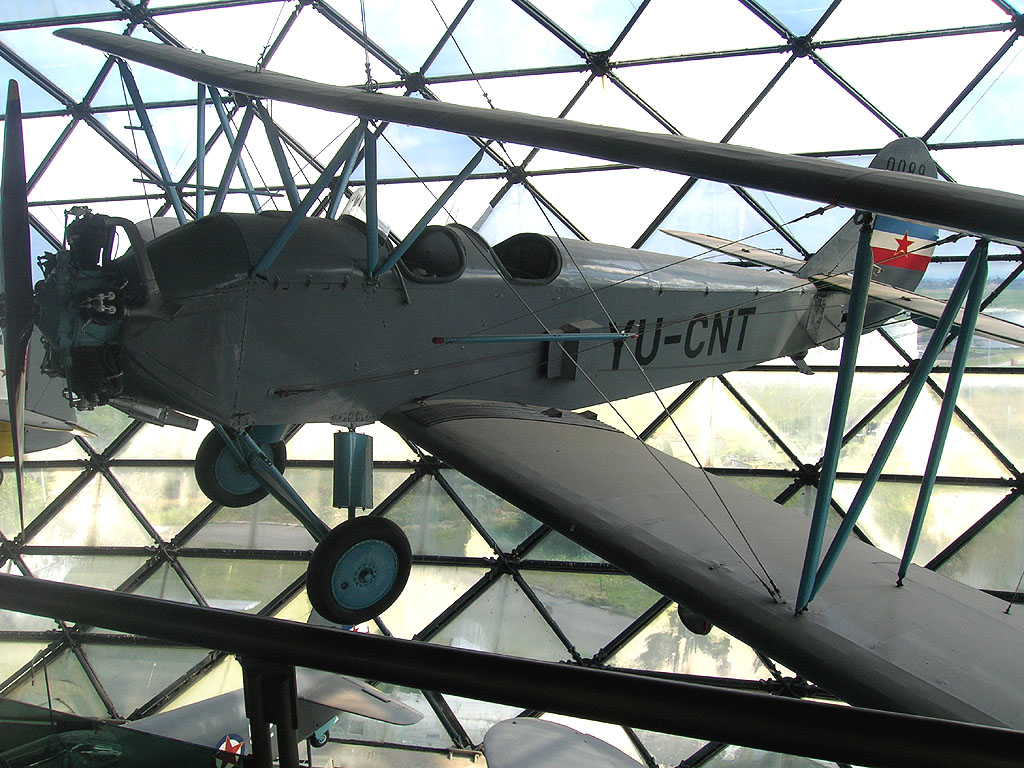
A Polikarpov Po-2 with Yugoslav markings, Belgrade Aviation Museum. Photo by Marko M, CC BY-SA 3.0, via Wikimedia Commons.
Flying the "sewing machine"
German troops gave the Po-2 another nickname — the "sewing machine," for the puttering drone of its engine. By day, it would have been target practice. The regiment therefore owned the night. Crews flew in pairs of open cockpits — pilot in front, navigator behind — navigating by map, compass, stopwatch and flashlight, in all weathers, through winters in which the slipstream could freeze exposed skin. There was, for most of the war, no radio in the aircraft and no radar anywhere in the regiment's world. The navigator also served as bombardier, releasing the small bomb load — the Po-2 could carry only a few hundred kilograms — by hand and eye.
Because the load was so small, one pass was never enough. Crews routinely flew eight, ten, or more sorties in a single night, landing at rough forward strips to be refuelled and re-armed by the regiment's women mechanics and armourers, then taking off again into the dark. Across a night, a single crew might deliver more total weight than one pass by a larger bomber — in instalments, all of them aimed. The regiment's statistics are recorded with unusual consistency across sources: 23,672 combat sorties, 28,676 flying hours, more than 3,000 tons of bombs. Individual records stagger belief until you remember the multiple-sortie system: Irina Sebrova flew 1,008 combat sorties, the regiment's highest total; Nadezhda Popova — who became one of its best-known pilots and flight commanders — flew 852, was shot down several times, and was never wounded.
The glide, the nickname, and the legends — checked
The regiment's signature tactic made its reputation. Approaching the target, the pilot would throttle back or idle the engine and glide the last distance in near-silence, so German troops heard only wind in the rigging wires before the bombs fell. Then the engine would restart at low altitude — too low and too slow, perversely, for fast fighters to engage easily, and flying beneath the effective engagement pattern of much anti-aircraft fire, though searchlights, flak and night fighters still killed crews throughout the war. Harassment was the mission as much as destruction: troops who cannot sleep, whose fuel dumps burn and whose positions are probed hourly, degrade fast. The regiment supported ground forces from the Caucasus in 1942, through the liberation of Crimea and Belarus, into Poland, and finally over Germany itself in 1945, flying its last missions in the war's closing days in early May 1945. On 8 February 1943 the regiment had been granted the elite "Guards" designation — becoming the 46th Guards — and later added the honorific "Taman" for its part in the Taman Peninsula fighting. It was disbanded after the war, in late 1945.
Now the legends, because this regiment attracts them and ChroniVara checks them:
- The broomstick sound. The famous explanation — that gliding Po-2s sounded like a witch's broomstick sweeping, hence "Night Witches" — is repeated everywhere. The Smithsonian's National Air and Space Museum treats that explanation as folklore: there is no recording of what the aircraft sounded like from the ground, and the nickname's exact origin is not documented. What is documented is the nickname itself: a Soviet newspaper article of March 1945 quotes navigator Rufina Gasheva reporting that German soldiers called the Po-2 pilots "night witches." The name is real. The broomstick acoustics are a good story, unproven.
- The automatic Iron Cross. Popular accounts claim any German pilot who shot down a Night Witch automatically received the Iron Cross. No wartime German order confirming such a blanket policy has ever been found. Treat it as legend, not policy.
- "Over 30,000 missions." Some popular retellings inflate the total past 30,000. The consistently recorded figure for the regiment is 23,672 combat sorties — remarkable enough without inflation, and the figure used here.
Casualty honesty matters too. The regiment's work was genuinely dangerous — slow, flammable aircraft at low altitude over alert defences. Thirty members of the regiment died during the war in the commonly cited accounting (published figures for deaths vary slightly by source and by whether all causes are counted), and twenty-three of its women were awarded the title Hero of the Soviet Union — the count most often given is 23 or 24, depending on whether post-war awards are included. Where sources differ, this article gives the range rather than a false precision.
Why the Night Witches were forgotten — and remembered
After 1945, the regiment's members were expected to return quietly to civilian life, and for decades their story was little known outside the Soviet Union — and not especially celebrated inside it, either. The aircraft helped bury them: harassment bombing by obsolete trainers did not fit post-war epics built around tank armies and jet fighters. The recovery of their history owes much to the women themselves, to veterans' memoirs, and to researchers such as Anne Noggle, whose interviews and photographs of Soviet airwomen are now preserved in the Smithsonian's National Air and Space Museum archives — the same archives that hold the documentary trail of all three of Raskova's regiments.
What the record establishes needs no embroidery. In October 1941, a country fighting invasion made a decision no other major power matched in the same way: it built entire combat air regiments of women and sent them to the front. The least-equipped of them took a crop-duster with a top speed under a hundred miles an hour, invented a way of war around its weaknesses, and flew more combat sorties than formations many times its size — 23,672 of them, at night, in open cockpits, for three years, until the war ended over Germany. The Germans who named them witches meant it as an insult born of fear. The women kept the name. History has decided they were right to.
References
- Smithsonian Institution, National Air and Space Museum Archives — "Women's Air Force Service Pilots (WASP) and Soviet Women Pilots Photographs [Noggle]" (formation of the 586th, 587th and 588th from the 122nd Composite Air Group at Engels; 588th renamed 46th "Taman" Guards, nicknamed die Nachthexen): https://sirismm.si.edu/EADpdfs/NASM.2021.0014.pdf
- Smithsonian Libraries and Archives — Bruce Myles, Night Witches: The Untold Story of Soviet Women in Combat (catalogue record): https://www.si.edu/object/siris_sil_195561
- Regiment record summary — 23,672 combat sorties, 28,676 flight hours, 3,000+ tons of bombs and 26,000 incendiary shells; Bershanskaya's command; Guards redesignation 8 February 1943: https://zlatti71.substack.com/p/the-night-witches
- Po-2 technical record — 1928 Nikolai Polikarpov design, trainer/crop-duster origins, service history: https://en.wikipedia.org/wiki/Polikarpov_Po-2
Fact notes: The broomstick-sound origin and the "automatic Iron Cross" claim are explicitly flagged in the article as folklore/legend, following the Smithsonian's assessment as reported in the sources consulted. Hero of the Soviet Union and death totals are given as ranges because reputable sources differ slightly. The 30,000+ sorties figure found in some popular accounts was NOT used; the documented 23,672 figure was used instead.
Comments
Post a Comment