

Loren Mozley, Pueblo Rebellion, 1936, U.S. Courthouse, Albuquerque — public domain (U.S. federal government work), via Wikimedia Commons.
The Pueblo Revolt of 1680: The Rebellion That Drove Spain Out of New Mexico
In August 1680, nearly a century before Americans declared independence from Britain, another American people won one of their own. The Pueblo peoples of New Mexico — dozens of farming villages speaking six different languages — rose up as one, drove out every Spaniard in the province, and kept their homeland free for twelve years.
It was the most successful Native American uprising against European rule in North America. And it began with a flogged holy man, a knotted cord, and a plan carried on foot across some 400 miles of desert.
A hundred years of Spanish rule
The Spanish first came to the Pueblo world in 1540, when Francisco Vázquez de Coronado led an expedition into what is now New Mexico. That winter, his men fought the Tiguex War against the Tiwa pueblos — a brutal opening to a relationship that would only get worse.
Permanent colonization began in 1598, when Juan de Oñate led 129 soldiers and 10 Franciscan priests, with families, servants and livestock, into the Rio Grande valley. Around 40,000 Pueblo people lived there then, in farming towns the Spanish called pueblos. Within a year, Oñate made an example of Acoma Pueblo: after Acoma warriors killed twelve Spanish soldiers, his troops stormed the cliff-top town, seized some 600 men, women and children, and sentenced the men aged 25 and older to have a foot cut off — a punishment remembered for generations.
In 1610 the Spanish founded Santa Fe and built the Palace of the Governors, the adobe seat of colonial government still standing on the plaza today — the oldest continuously occupied public building in the United States. Around it grew a system built on Pueblo labour: encomiendas let colonists demand tribute and work from the villages, while Franciscan missionaries set up theocracies determined to replace the old religion with Christianity.
The attack on Pueblo religion was the deepest wound. Franciscan priests banned the kachina dances, seized and burned masks, prayer sticks and sacred effigies, and punished anyone caught practising the old ceremonies.
Then, in the 1670s, drought swept the region: crops failed, famine set in, and Apache raids grew bolder. A Franciscan wrote to the king that Spaniards and Indians alike were reduced to eating "hides and straps of carts".
The flogging that lit the fuse
In 1675, Governor Juan Francisco Treviño ordered the arrest of 47 Pueblo religious leaders, accusing them of practising "sorcery". Four were sentenced to hang; three of the sentences were carried out and the fourth man took his own life. The rest were publicly whipped and imprisoned.
When the news reached the pueblos, their leaders marched on Santa Fe in force and demanded the prisoners' release. With most Spanish soldiers away fighting the Apache, Treviño had no choice: he freed them.
Among those released was a Tewa religious leader from Ohkay Owingeh (San Juan Pueblo) named Popé, also spelled Po'pay. Born around 1630, he was a respected medicine man — and the flogging of 1675 turned him into the architect of the greatest revolt in the Southwest.
The knotted cord
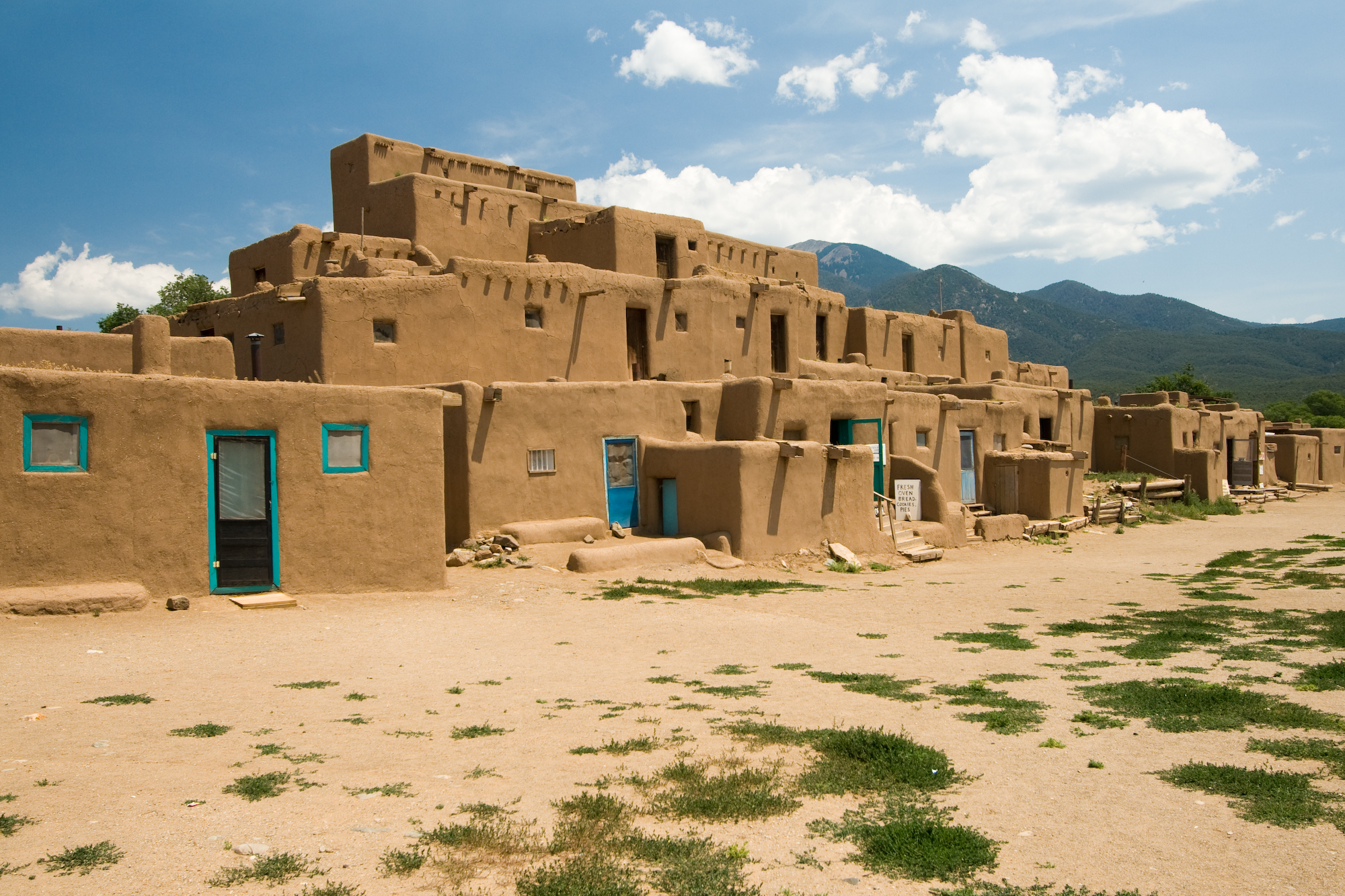
Taos Pueblo, Popé's base during the revolt — photo by Luca Galuzzi, CC BY-SA 2.5, via Wikimedia Commons.
After his release, Popé took refuge at Taos Pueblo, about 70 miles north of Santa Fe, and spent five years building what no one had built before: a united Pueblo alliance. He won the support of 46 pueblo towns — Tewa, Tiwa, Towa, Tano, Keres and Zuni, plus the Hopi villages 200 miles west — peoples who spoke six different languages and had never acted together. Spanish, the colonists' own language, became the revolt's lingua franca.
The plan was simple: runners would carry knotted cords of maguey fibre to every pueblo, and each morning the leaders would untie one knot. When the last knot was undone, every pueblo would rise at once — on 11 August 1680.
Forty-six villages, six languages, one signal: a knotted cord carried by runners on foot across 400 miles of desert, timed to the day.
On 8 August, two young runners from Tesuque Pueblo, Pedro Omtua and Nicolas Catua, set out for the Tano villages. Captured on 9 August and tortured, they revealed what the cord meant. Popé ordered the rising brought forward a day; the distant Hopi pueblos, who never got the message, kept to the original date.
Ten days in August
On 10 August 1680, the pueblos rose. Warriors seized the Spaniards' horses, sealed the roads to Santa Fe, and attacked settlements and missions across the province. About 400 Spaniards were killed, including 21 of the 33 Franciscan missionaries in New Mexico; churches were burned and destroyed. The number of Pueblo people killed was not recorded.
By 13 August, every Spanish settlement outside Santa Fe had been destroyed, and the capital was besieged: Pueblo warriors surrounded the city and cut off its water supply while Governor Antonio de Otermín held out inside the Palace of the Governors.
On 21 August, Otermín broke out with all his available men, forced the besiegers back, and led the survivors out of the city. About 2,000 settlers — along with some 500 Native servants — fled south along the Rio Grande toward El Paso del Norte, shadowed but not attacked by the Pueblos. On 6 September the refugee columns met at Socorro; two days later, Otermín wrote his account of the revolt to the viceroy, a letter that survives today.
In eleven days, Spanish rule in New Mexico was over. The Pueblos had done what no other Native people in North America would ever do: expel a European colonial power completely.
Twelve years of freedom
With the Spanish gone, Popé and his lieutenants ordered a return to the old ways: churches and crosses destroyed, Christian images burned, baptism washed away in ritual baths, Pueblo names taken back, Catholic marriages dismissed, Spanish livestock slaughtered and fruit trees cut down.
But freedom proved hard to govern: the drought continued, crops failed, and Apache raids increased. Popé, who had promised that the ancient gods would reward the people with health and prosperity, was deposed about a year after the revolt. He disappears from history after that, believed to have died shortly before the Spanish returned.
The Spanish tried to come back sooner. In November 1681, Otermín marched north from El Paso with 146 Spanish soldiers and as many Native auxiliaries. He reached Isleta Pueblo, fought a brief battle, and spent weeks questioning prisoners about who had led the revolt — and got only the names of gods in reply. On 1 January 1682, with a Pueblo army gathering, he burned pueblos, seized the people of Isleta, and retreated. The first reconquest had failed.
The return of Spain — and what had changed
The Spanish did return, but slowly, and for reasons of their own: they feared French advances down the Mississippi and wanted a defensive frontier. In August 1692, Governor Diego de Vargas marched to Santa Fe with only 60 soldiers, 100 Native auxiliaries, seven cannons and one Franciscan priest. On 13 September he arrived, promised clemency to the 1,000 Pueblo people gathered there, and on 14 September proclaimed the formal repossession of New Mexico — bloodlessly.
It did not stay bloodless. De Vargas returned in December 1693 with some 800 settlers; when 70 Pueblo warriors and their families resisted his entry into Santa Fe, his troops retook the town by force, executed the warriors on 30 December, and sentenced their families to ten years of servitude. In 1696, fourteen pueblos tried a second organised revolt, killing five missionaries and 34 settlers; de Vargas crushed it without mercy. By the end of the century the reconquest was complete.
Yet the New Mexico the Spanish retook was not the one they had lost. The Franciscans never again tried to impose a theocracy, and Pueblo people kept practising their traditional religion. The Spanish issued substantial land grants to each pueblo and appointed a public defender to argue Native cases in Spanish courts. The Hopi, far to the west, were never reconquered at all.
Why it still matters

Taos Pueblo, photographed by Ansel Adams for the National Park Service, 1933–1942 — public domain, via Wikimedia Commons / U.S. National Archives.
The revolt's legacy stands in the United States Capitol. In 2005, New Mexico placed a seven-foot statue of Po'pay — carved by Cliff Fragua of Jemez Pueblo from a single block of pink Tennessee marble — in the National Statuary Hall Collection, one of the state's two statues. It was the 100th statue in the collection, and the only one honouring resistance to a colonial power. Fragua carved the scars of Popé's 1675 flogging into the statue's back; in its left hand, Po'pay holds the knotted cord.
Historians call the Pueblo Revolt the first American revolution — 96 years before 1776, it succeeded for twelve years where the later revolution took eight years of war. The Palace of the Governors, where Otermín was besieged, still stands on the Santa Fe plaza, now part of the New Mexico History Museum.
The revolt did not end Spanish rule forever — but it ended the attempt to erase Pueblo culture. Nineteen Pueblo nations endure in New Mexico today, each a sovereign nation, still speaking their languages and keeping their ceremonies.
That is the real measure of August 1680. The Spanish came back, but to a different New Mexico — one in which the Pueblo peoples had proved they could unite, rise, and win, and in which their religion and identity would survive.
Read our article on Cahokia, the Native American city larger than London in 1100, and browse the Native American History archive.
References
- Smithsonian Magazine / National Museum of the American Indian — Dennis Zotigh, "In 1680, Pueblo Natives in the Southwest Launched the First Successful, Although Short-Lived, American Revolution" (2 September 2026): https://www.smithsonianmag.com/blogs/national-museum-american-indian/2026/09/02/pueblo-natives-southwest-launched-first-successful-shortlived-american-revolution/?itm_source=related-content&itm_medium=parsely-api
- Encyclopaedia Britannica — "Pueblo Rebellion": https://www.britannica.com/event/Pueblo-Rebellion
- Encyclopaedia Britannica — "Popé": http://www.britannica.com/EBchecked/topic/470012/Pope
- EBSCO Research Starters — "Pueblo Revolt": https://www.ebsco.com/research-starters/history/pueblo-revolt
- University of Pennsylvania Museum, Expedition Magazine — "Living on the Mesa": https://www.penn.museum/sites/expedition/living-on-the-mesa/
- University of Houston, Digital History — Governor Antonio de Otermín's letter on the Pueblo Revolt, 8 September 1680: https://www.digitalhistory.uh.edu/disp_textbook_print.cfm?smtid=3&psid=526
- U.S. National Park Service — "Palace of the Governors": https://home.nps.gov/articles/000/new-mexico-palace-of-the-governors.htm
- U.S. National Park Service — "Visiting New Mexico Pueblos": https://www.nps.gov/petr/planyourvisit/pueblos.htm
- Architect of the Capitol — "Po'pay Statue, U.S. Capitol for New Mexico": https://admin.aoc.gov/explore-capitol-campus/art/popay-statue
Fact notes: Spanish dead are given as about 400, including 21 of the 33 Franciscan missionaries; Pueblo dead were not recorded. Whether the Acoma foot-amputation sentences of 1599 were actually carried out is debated by historians. Popé disappears from the record after his deposition and is believed to have died shortly before the 1692 reconquest, though some sources give 1692. The number of knots on the runners' cords is debated. The claim that the revolt spread horses onto the Great Plains is also debated — studies suggest a Native horse culture was already established by the first half of the 17th century. "First American revolution" is a historians' description, not a contemporary label.
Comments
Post a Comment