
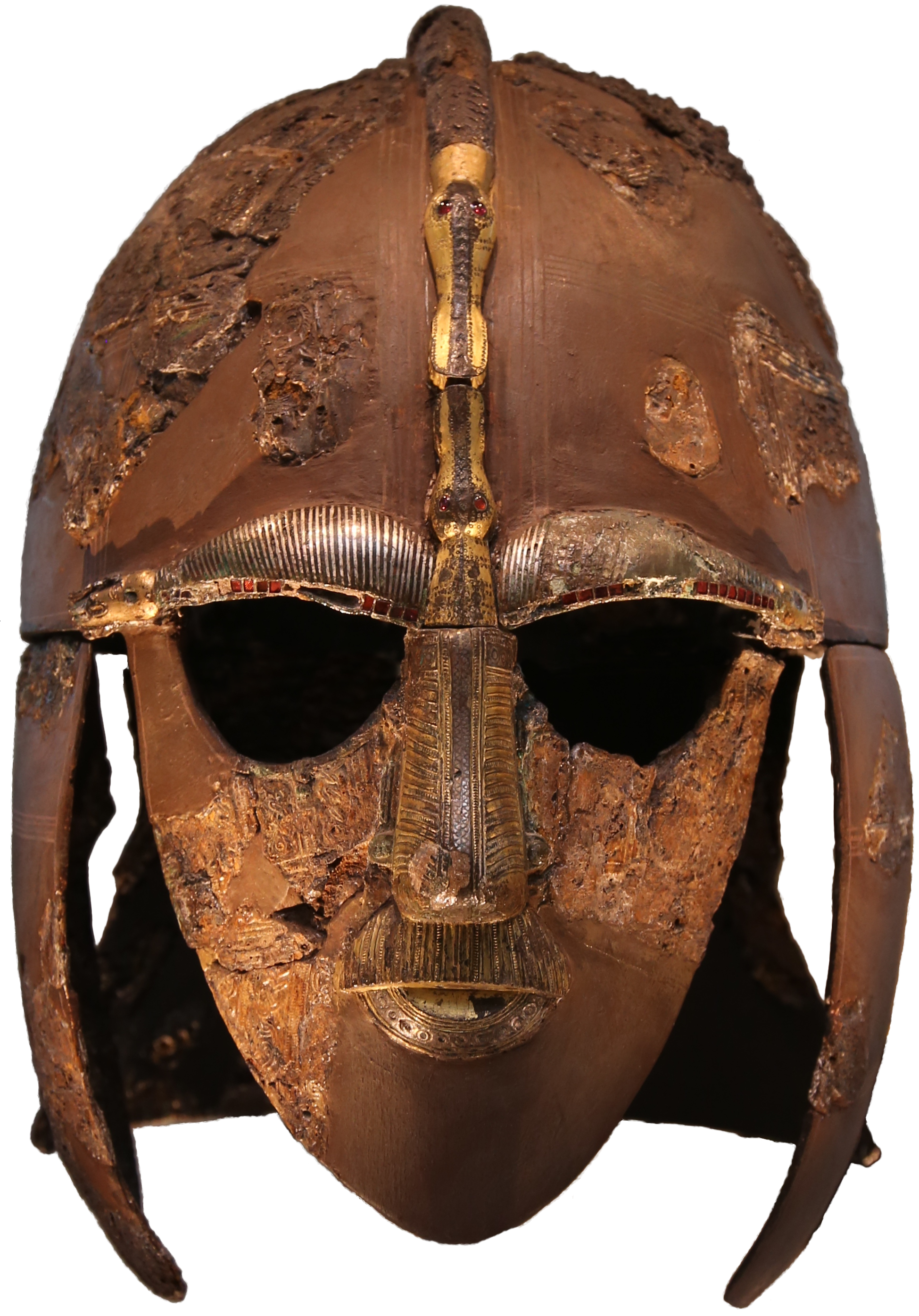
The reconstructed Sutton Hoo helmet, British Museum. Photo by geni, CC BY-SA 4.0, via Wikimedia Commons.
In the summer of 1939, weeks before the Second World War began, a self-taught Suffolk archaeologist named Basil Brown was digging into a grassy mound on a ridge above the River Deben, on the estate of a widow named Edith Pretty. Brown was good — methodical, experienced, and working almost alone with two estate labourers. As he dug into the largest mound, his spade began tracing something no one expected in an English field: the ghost of a ship. The wood had long since rotted away in the acidic sand, but every iron rivet remained in place, and the sand itself held the vessel's shape like a mould — a ship 27 metres (about 89 feet) long, buried whole beneath the mound, with a treasure chamber at its heart.
What came out of that chamber changed what Britain knew about itself. Gold jewellery set with garnets from Sri Lanka. Silver vessels from the Byzantine Empire. A great iron helmet, a sword, a shield, feasting equipment worthy of legend. The Sutton Hoo ship burial, as the British Museum puts it, is one of the greatest archaeological discoveries of all time — and its real importance is not the gold. It is what the gold proved: that the England of the early 600s, long dismissed as a primitive "Dark Age," was wealthy, artistically brilliant, and connected to a world stretching from Scandinavia to Constantinople and beyond.
A kingdom in a neglected age
To understand why Sutton Hoo shocked scholars, you need the picture it shattered. After Roman Britain collapsed in the early fifth century, written history for England thins to almost nothing for two hundred years. Later generations filled the silence with an assumption: that the Anglo-Saxon kingdoms of the sixth and seventh centuries were crude, poor and isolated — longships, mud huts and barbarism between Rome and the Normans.
Sutton Hoo stood in one of those kingdoms: East Anglia, covering modern Suffolk and Norfolk, ruled in the early seventh century by kings of the Wuffingas dynasty. The burial ground Brown was digging was a royal cemetery on the ridge at Sutton Hoo, near Woodbridge — a cluster of mounds raised over generations, most of them robbed in earlier centuries. Mound 1, the largest, had somehow escaped the robbers. Edith Pretty, who had inherited the estate and long wondered about the mounds, commissioned Brown in 1938 to investigate the smaller ones first. In 1939 she asked him to open the great mound. It was her decision, her funding, and — as events would prove — her discovery as much as anyone's.

The great gold buckle from Sutton Hoo, British Museum. Photo by geni, CC BY-SA 4.0, via Wikimedia Commons.
The ghost ship and the chamber of treasures
Brown's excavation of the ship's imprint was a masterpiece of care: a fragile sand sculpture of a vessel, held together by rivets, which dissolved if mishandled. At the ship's centre sat a collapsed burial chamber. When news of gold reached the wider archaeological world, a professional team under Charles Phillips of Cambridge took over the chamber excavation — a handover that has been debated ever since, though Brown continued working at the site and his foundational role is now fully recognised.
The inventory still reads like a poem — deliberately so, since scholars immediately compared it to the ship funeral in the Old English epic Beowulf, in which a king's body is laid in a ship amid treasures. In the chamber lay, among much else:
- The helmet — an iron cap with a face mask, its panels decorated with dancing warriors, a flying creature, and interlace, reconstructed from hundreds of crushed fragments. Only four complete helmets are known from all of Anglo-Saxon England; this became the face of an age.
- Gold dress fittings — shoulder clasps, a great gold belt buckle and a purse lid, all worked in cloisonné and set with garnets that geological analysis traces to sources as distant as Sri Lanka.
- The sword and shield — a pattern-welded sword with a gold and garnet hilt, beside a great round shield with animal ornament, of Scandinavian character.
- Byzantine silver — including a large silver platter stamped with control stamps of the Emperor Anastasius I, and a set of ten nested silver bowls — objects made in the eastern Roman world and carried across a continent.
- Feasting and ceremony — great hanging bowls, a cauldron and chain, drinking vessels, a lyre in a beaver-skin bag, spoons inscribed in Greek lettering, a whetstone sceptre topped with a bronze stag, and 37 gold coins in the purse, each from a different Frankish mint, with three coin-shaped blanks and two small ingots.
One thing was missing: a body. No skeleton survived — the acidic soil had dissolved bone almost completely. Chemical traces in the sand are consistent with a body having lain in the chamber, but no identifiable remains were recovered. The grave's occupant is known only by what his mourners sent with him.
Whose ship was it? The Raedwald question — honestly stated
The burial can be dated by its coins: the purse's contents point to a deposition sometime around 610–635. That window, the East Anglian location, and the burial's royal scale have led most scholars to one leading candidate: Raedwald, king of the East Angles, who died around 624–625. Raedwald was no petty chief. The Venerable Bede's history records him as holding overlordship — imperium — over the kingdoms south of the Humber, and his victory at the Battle of the Idle in 616 had made him the most powerful king in England. Bede also tells a famously human story about him: Raedwald, baptised into Christianity, kept both a Christian altar and a pagan altar in the same temple — hedging his bets between the old gods and the new. Scholars have noted Christian and pagan elements side by side in the Sutton Hoo chamber too.
But honesty requires the label the British Museum itself uses: the burial "may even have belonged to a king," and Raedwald is the most likely candidate, not a proven one. There is no inscription, no name ring, no body to test. Other East Anglian royals of the right decades have their advocates. The correct sentence — and the one this article stands by — is: the Sutton Hoo ship burial commemorated a leading figure of East Anglia, most plausibly King Raedwald, but his identity is not certain. Any source that states it as settled fact is ahead of the evidence.
Edith Pretty's gift, and a second excavation
In August 1939, a treasure trove inquest ruled the finds legally Edith Pretty's property. She immediately gave the entire treasure to the nation — at the time, the largest gift ever made to the British Museum by a living donor. The objects went to London, were hidden away for safety as war broke out, and the mound was backfilled; the site saw wartime use before archaeology returned. A major second campaign, led by Rupert Bruce-Mitford in the 1960s and 1970s, re-excavated the ship, published the finds in definitive volumes, and reconstructed the shattered helmet into the icon it is today. Later fieldwork under Martin Carver (1983–1992) mapped the whole cemetery, and the wider landscape has since proved far older — people had used this ridge for millennia before the Anglo-Saxons. Since 2009, comparison with the Staffordshire Hoard has deepened the picture further, showing that Sutton Hoo's goldsmiths could deliberately manipulate gold surfaces to enhance garnet colour — craftsmanship of a sophistication that can, in the British Museum's words, "barely be fathomed."
How one grave ended the "Dark Ages"
The revolution Sutton Hoo caused can be stated simply. Before 1939, the early Anglo-Saxon period could be condescended to; the evidence was thin, and thin evidence invites lazy conclusions. After 1939, it could not. Here, in material form, was an English court of the early 600s trading, directly or through intermediaries, with Byzantium and Sri Lanka; commissioning goldwork equal to anything in Europe; practising a ship-burial rite straight out of the Beowulf world; and staging a funeral that must have involved hauling a 27-metre seagoing ship uphill from the Deben and burying it under a mound some 30 metres across. The "Dark Ages" did not fall because scholars became politer. They fell because a widow asked a good question about the mounds in her field, and a local archaeologist dug carefully enough to answer it.
The treasure is on permanent display in Room 41 of the British Museum, the Sutton Hoo gallery, where the reconstructed helmet — and a replica showing its original appearance — anchor the collection. The site itself, with its mounds and the ship's full-scale footprint, is cared for by the National Trust, which also preserves Tranmer House, Edith Pretty's home. Stand on the ridge at Sutton Hoo today and the Deben glitters below exactly as it did when the ship was dragged up from it, fourteen centuries ago, to carry a king — probably Raedwald, possibly another great East Anglian — out of a world we are only now learning to see clearly.
References
- British Museum — "Eighty years (and more) of Sutton Hoo" (27-metre ship; mound nearly 3 m high and 30 m across; Edith Pretty and Basil Brown, 1939; treasure trove gift to the nation; Sri Lankan garnets and Byzantine silver): https://www.britishmuseum.org/blog/eighty-years-and-more-sutton-hoo
- British Museum — "Sutton Hoo and Europe," Room 41 gallery (burial dated early AD 600s; coins suggesting deposition c. 610–635 and a possible link to King Raedwald, d. c. 625; only four complete Anglo-Saxon helmets known): https://www.britishmuseum.org/collection/galleries/sutton-hoo-and-europe
- Smithsonian Magazine — "The True History Behind Netflix's The Dig and Sutton Hoo" (Basil Brown photograph public domain via Wikimedia Commons; excavation narrative): https://www.smithsonianmag.com/history/true-history-behind-netflixs-dig-and-sutton-hoo-180976923/
Fact notes: The occupant's identity is presented throughout as "most plausibly Raedwald, not proven," matching the British Museum's own caution. No body survived the acidic soil — articles claiming skeletal remains are wrong. Anastasius platter and coin details follow the British Museum's published descriptions.
Comments
Post a Comment