
 |
| Albert Bierstadt's 'View of Donner Lake, California' (1871–1872) — the lake where the Donner Party wintered; public domain, via Wikimedia Commons. |
In the spring of 1846, eighty-seven American emigrants set out from the Midwest for California in twenty-three ox-drawn wagons, bound for new farms on the Pacific coast. They never arrived together. By the following spring, thirty-nine of them were dead in the Sierra Nevada snows, and the survivors had lived through a winter so terrible that the name of their captain — George Donner — became an American byword for disaster.
The Donner Party was not unlucky in the ordinary sense. It was undone by a decision: to trust a shortcut its promoter had never travelled with wagons, in a year when the snows came early.
A shortcut sold on a promise
The party began as two families from Springfield, Illinois: the Donners, led by sixty-year-old George Donner and his younger brother Jacob, and the Reeds, led by cabinetmaker James Reed. They left Independence, Missouri, on 12 May 1846, at the rear of a great migration — nearly five hundred wagons headed west that spring — and joined a fifty-wagon train led by William H. Russell. Timing was everything: a wagon train had to cross the Sierra Nevada before the autumn snows closed the passes.
On 12 July, at the Little Sandy River in present-day Wyoming, the travellers received a letter from Lansford Hastings, a California promoter. Hastings had published The Emigrants' Guide to Oregon and California in 1845, and in it he advertised a new route — the Hastings Cutoff — that he claimed would save some 300 miles on the journey to California. His letter promised he would meet the emigrants at Fort Bridger and guide them along it. What Hastings did not say was that he had never travelled any part of his proposed shortcut with wagons; he was only the second person documented to have crossed the southern Great Salt Lake Desert at all, and he had done it on horseback.
At the fork on 20 July, most of the wagon train kept to the established trail through Fort Hall. A smaller group — the Donners, the Reeds and the families travelling with them — turned south toward Fort Bridger and elected George Donner, steady and well liked, as their captain. When they reached Fort Bridger on 27 July, Hastings had already gone. The trader Jim Bridger, whose post stood to profit if the cutoff caught on, assured them the shortcut was a smooth trip that would shorten the journey by 350 miles. James Clyman, coming the other way from California, warned Reed not to take it — wagons could not make it, he said. Reed chose to believe Bridger, and on 31 July the party set out, eleven days behind the group ahead of them, into country no wagon had ever crossed.
The desert that ate the oxen
The cutoff punished them almost at once. In the Wasatch Range of present-day Utah, there was no road at all: the emigrants spent days hacking one through brush and boulders, while Hastings left directions pinned to trees and rode back only part of the way to meet them. Then came the Great Salt Lake Desert — eighty miles of salt flats with no water. Hastings had promised a two-day crossing of forty miles. It took five or six days, in blistering heat by day and freezing wind by night, and it cost them dozens of oxen, which died of thirst or bolted into the desert. Families abandoned wagons and dumped their belongings on the salt to lighten the loads. The "shortcut" had actually added about 125 miles to their journey, and they were now a month behind schedule.
Worse followed on the Humboldt River in Nevada, where Paiute people stole or shot many of their remaining oxen and horses. By early October the party was fracturing. Near the Humboldt, two wagons tangled, and a teamster named John Snyder angrily beat the ox of Reed's hired driver, Milt Elliott. When Reed intervened, Snyder struck him on the head with a whip handle and struck Reed's wife too. Reed answered by fatally stabbing Snyder. Some wanted Reed hanged, but a compromise was struck — Reed would ride ahead alone to California, leaving his family in the care of the others.
Snow at Truckee Lake
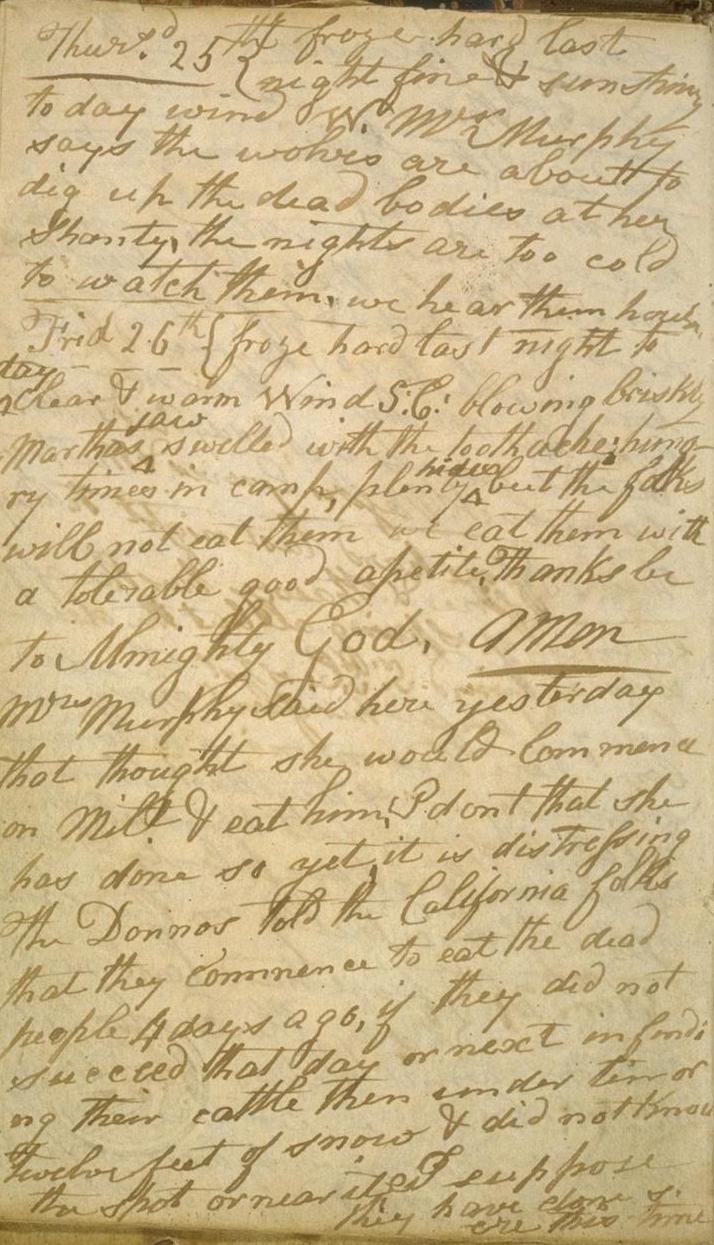 |
| Page 28 of Patrick Breen's diary, 25–26 February 1847 — the only contemporary written record of the winter; public domain, via Wikimedia Commons (Bancroft Library, UC Berkeley). |
On 28 October 1846 the exhausted party camped beside Truckee Lake — now Donner Lake — high in the Sierra Nevada, thirteen and a half miles north-west of Lake Tahoe. Three days later, snow blocked the pass ahead of them.
The Donners themselves never reached the lake: a broken wagon axle had delayed George Donner's family, and they camped about six miles back along the trail at Alder Creek. The rest built crude cabins beside the lake as the snow kept falling. By January it lay more than ten feet deep, burying the cabins to their roofs.
Patrick Breen, an Irish immigrant travelling with his wife and seven children, kept the only contemporary written record of that winter. His diary, begun on 20 November 1846 and kept until 1 March 1847, is terse and terrible: the weather, the dwindling cattle, the deaths, one by one. On 15 December, Baylis Williams, a handyman of the Reed family, died of malnutrition — the first death in the camps. The cattle were slaughtered and eaten; then the dogs, the mice, the ox hides boiled until they softened into a gluey broth. By February, thirteen people lay dead at the camps, their bodies loosely buried in the snow beside the cabin roofs.
The Forlorn Hope
On 16 December, fifteen of the strongest emigrants — ten men and five women — set out west on crude snowshoes, carrying barely six days' rations, to walk out over the mountains and fetch help. They became known as the Forlorn Hope. Charles Stanton, who had ridden ahead to Sutter's Fort for supplies and returned with two Miwok guides, went snowblind within days and stayed behind in the snow to die rather than hold the others back. A three-day storm caught the rest; they lost their way, and seven of them died. The survivors, driven past endurance, ate the bodies of the dead — and, in the one act of the winter that went beyond eating those already dead, killed and ate the two Miwok guides.
About a month later, two men and all five women reached a ranch forty miles north of Sutter's Fort. The news spread fast: residents of Yerba Buena raised $1,300, and a rescue party left Sutter's Fort on 31 January 1847.
Rescue, in three waves
 |
| Stumps of trees cut by the Donner Party, photographed in 1866 — their height shows the depth of the snow; public domain, via Wikimedia Commons (Library of Congress). |
On 18 February 1847, seven rescuers scaled the pass and reached the buried cabins at Truckee Lake. A haggard woman appeared from a hole in the snow and asked, "Are you men from California, or do you come from heaven?"
The first relief party found the cabins buried, the ox-hide roofs rotting, and the survivors starving and half out of their minds. They fed them in small portions, fearing that a full meal might kill the emaciated. Twenty-three people — seventeen of them children — were chosen to leave with the rescuers. The walk out was itself a trial: food caches had been broken into by animals, and two of the party died on the trail. The survivors reached Sutter's Fort, where thirteen-year-old Virginia Reed wrote that she "really thought I had stepped over into paradise."
A second relief party arrived at the lake on 1 March, bringing James Reed back to his family, and evacuated seventeen more people. A third relief reached the camps on 14 March and took out the Donner girls, Eliza, Georgia and Frances, with young Simon Murphy and two others. Behind them, the camps emptied in the cruellest order: George Donner, his arm gangrenous from infection, died at Alder Creek in late March; his wife Tamsen, who had refused twice to leave him, died at the lake camp soon after. The last survivor to leave was Lewis Keseberg, found alone among the dead on 21 April 1847 — a year after the wagons had left Illinois.
Of the eighty-seven people who had entered the Wasatch Mountains, forty-eight survived. Five had died before the party reached the lake; thirty-four more died between December and April, twenty-five of them men and nine women. Isabella Breen, eleven months old in the snowbound cabins, lived to be the last survivor of the party; she died in 1935.
What the Donner Party still teaches
The party is usually remembered for one word — cannibalism — and it is true that some of the emigrants ate the dead to live. But the cannibalism was the end of the story, not its cause. The cause was a chain of human decisions: a promoter selling a route he had never tested, a trader talking it up for his own profit, and a party that listened to the men who told them what they wanted to hear and ignored the one man who had actually made the crossing.
The shortcut did not merely fail to save time. It cost thirty-nine lives — and it was never used by wagons again.
The trail remembers them still. The lake where they wintered and the pass above it carry the Donner name, and the camp site is preserved in Donner Memorial State Park, created in 1927. In June 1847, soldiers of the Mormon Battalion under General Stephen Kearny buried the human remains at the camps and burned two of the cabins. The story endures not because it is a horror tale, but because it is a warning about the oldest American temptation: the promise of a faster way, sold by someone who has never walked it himself.
Read our article on the Orphan Trains, when 200,000 children were sent west to find a home, and browse the Forgotten History archive.
References
- Encyclopaedia Britannica — "Donner party"
- California State Parks — Donner Memorial State Park brochure (park history)
- HISTORY — "How the Donner Party Was Doomed By a Disastrous Shortcut"
- Wikipedia — "Donner Party"
Fact notes: The party is usually counted at 87 members, with 48 survivors and 39 dead; some sources count 89 or 91 by including people who left the train before the Sierra Nevada. The first relief party's arrival is given as 18 February 1847 by Britannica and Wikipedia; some popular accounts say 19 or 20 February. The Great Salt Lake Desert crossing is given as five days by some sources and six by others. The "300 miles saved" is Hastings's claim as reported by California State Parks; Bridger put the saving at 350 miles. The killing and eating of the two Miwok guides, Luis and Salvador, is recorded in the standard histories; the Forlorn Hope survivors' own accounts differ on details, and the article follows the documented record rather than later retellings.
Comments
Post a Comment